Most water heater repair calls happen at the worst possible hour, usually the morning after a tank has been quietly failing for months. The failure feels sudden. It rarely is. Tanks give off warnings for weeks, sometimes years, and almost all of those warnings are small enough to ignore until the shower turns cold.
Understanding the actual mechanics behind a water heater repair changes how homeowners read those early signals. A tank is a simple machine with roughly six moving or consumable parts, and each one fails in a recognizable way. Knowing which part is talking makes the difference between a forty dollar component and a flooded garage.
Sediment Is the Quiet Problem in Arizona Homes
Phoenix municipal water carries a heavy mineral load. Calcium and magnesium precipitate out when water is heated, then settle to the bottom of the tank as a dense grey layer. In a gas heater, that layer sits directly between the burner and the water it is supposed to heat. The burner runs longer to compensate. The steel floor of the tank runs hotter than the manufacturer intended.
That is where the popping and rumbling comes from. Small pockets of water trapped under the sediment flash to steam and force their way out. The sound is harmless on its own. The overheating underneath it is not, because sustained heat stress at the tank floor is what turns a fifteen year unit into a nine year unit.
Annual flushing removes most of it. Tanks that have gone five or six years without a flush often cannot be flushed safely, since the drain valve clogs immediately and the sediment has hardened into something closer to concrete than silt.
See also: 3 Lifestyle Benefits of Moving Into a Community Environment
The Anode Rod Nobody Thinks About
Inside every glass lined tank sits a sacrificial rod, usually magnesium or aluminum, threaded into the top. Its entire job is to corrode instead of the steel around it. Once that rod is consumed, the water goes to work on the tank itself.
Anode rods in hard water areas can be spent in three years. Homeowners who replace them on schedule routinely get twice the service life out of the same tank. Those who never check the rod usually discover the situation when rusty water appears at the tap or a pinhole opens at a weld seam. At that point, no repair applies. A leaking tank is a replacement.
Thermostats, Thermocouples, and Water That Is Almost Hot
Lukewarm water rather than no water at all points somewhere different. On a gas unit, the thermocouple is a common culprit. It sits in the pilot flame and generates a tiny electrical current that tells the gas valve to stay open. Soot, corrosion, or simple age weakens that current, and the valve starts shutting off intermittently.
Electric units run two heating elements, upper and lower. When the lower element burns out, the upper one keeps producing a small volume of hot water that disappears within a few minutes of running a shower. The pattern is distinctive: hot at first, cold fast, then recovering slowly. That symptom nearly always means one element rather than two.
Thermostats fail differently again. A drifting thermostat produces water that is either scalding or tepid with no obvious pattern, and it can be dangerous. Water above 140 degrees causes serious burns in seconds, which is why the Consumer Product Safety Commission has long recommended a setting of 120 degrees for most households.
Pressure Relief Valves Deserve More Attention Than They Get
The temperature and pressure relief valve is the only thing standing between a pressurized tank and a genuine explosion. It should discharge if internal pressure exceeds roughly 150 psi or temperature exceeds 210 degrees.
Two failure modes matter. A valve that weeps constantly usually signals excessive incoming pressure or thermal expansion with nowhere to go, often in homes with a closed system and no expansion tank. A valve that has seized shut signals nothing at all, which is the more dangerous condition. Mineral scale gums these valves regularly in hard water regions, and a seized valve gives no warning whatsoever.
Testing takes seconds. Lifting the lever should produce a burst of water into the drain line and a clean reseat afterwards. A valve that does not reseat, or does not open, needs replacing that day.
Deciding Between a Repair and a Replacement
Age carries most of the weight in this decision. Standard tanks last eight to twelve years in Phoenix, shorter than the national average because of mineral content and because garages here reach brutal ambient temperatures for months at a stretch.
A five year old heater with a bad element is worth fixing without hesitation. A twelve year old heater with the same fault is a harder call, since the elements are rarely the only thing worn. Repairs on tanks past their tenth year tend to be followed by another repair within eighteen months.
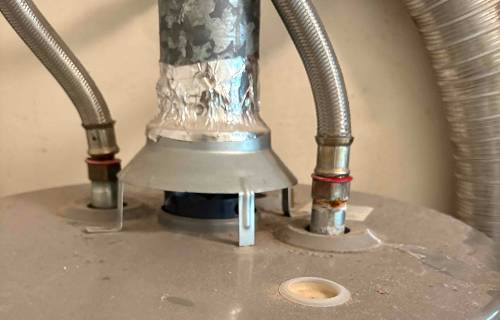
Corrosion at the base, moisture on the floor pan, or discoloration around fittings shifts the answer decisively. Steel that has begun to fail does not stop failing.
Maintenance Habits That Actually Extend Service Life
A flush once a year, an anode inspection every second or third year, a relief valve test each spring, and a check of the burner chamber for soot or scorching cover almost everything that matters. Licensed plumbers perform all four in a single visit, and the visit costs a fraction of an emergency replacement.
Gas units carry an added consideration. Combustion byproducts must vent cleanly, and a corroded or disconnected flue introduces carbon monoxide risk that no homeowner should assess alone. Licensed technicians carry combustion analyzers for exactly this reason. Guesswork has no place near a vented appliance.