
The most expensive cars in history are easy to admire. The McLaren F1, the Ferrari 250 GTO, the Bugatti Type 57 Atlantic — these are machines built without compromise, for buyers whose only constraint was their own imagination. Their stories are straightforward: extraordinary engineering, extraordinary money, extraordinary results. The interesting question is almost never asked about them. It is asked about the cars at the other end of the spectrum — the ones built to a price that seemed impossible, for buyers who had nothing to spare, in countries that could barely afford to have an automotive industry at all. Those are the cars whose stories stay with you.
Cheap cars are not simple cars. They are the product of ferocious constraint — engineering problems solved with the minimum of resources, political pressures absorbed into sheet metal and rubber, entire national ambitions compressed into a vehicle that costs less than a decent used sofa. Every one of them carries a story that the expensive cars do not. And the collector market, which has an instinct for meaning that transcends mere rarity, has never forgotten any of them.
The Ford Model T: The Car That Invented Affordability
When Henry Ford launched the Model T in 1908, it cost $825 — already cheaper than most competitors. By 1925, continuous production refinement had brought the price to $260. A Ford worker earning the company’s famous $5 daily wage could purchase the car their labour helped build within three months of starting work. No automobile manufacturer had attempted this equation before. No one had thought the equation was solvable.
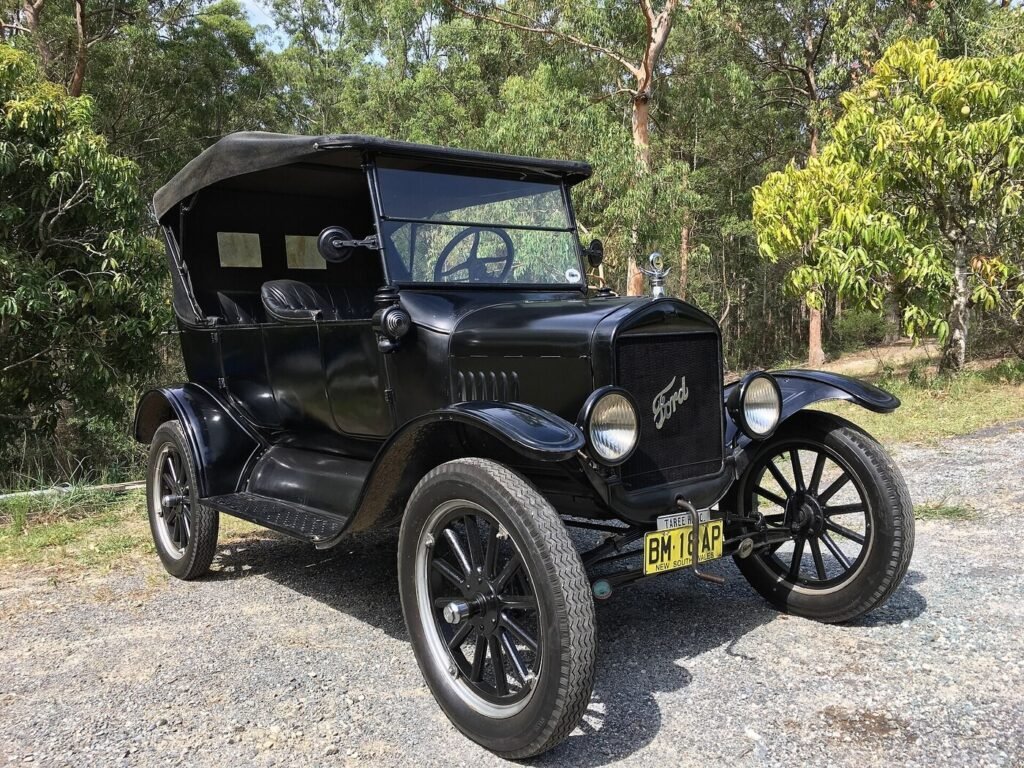
The Model T’s production story — the Highland Park plant, the moving assembly line, the deliberate de-skilling of manufacturing labour — is taught in business schools as a case study in industrial efficiency. What business schools rarely cover is the social consequence: fifteen million Model Ts produced between 1908 and 1927 did not merely create a new market. They restructured American geography, accelerated suburbanisation, killed the horse-drawn economy, and made personal mobility a democratic expectation rather than a class privilege. The models of automobiles produced from the Model T era represent not just a vehicle but an entire social revolution compressed into brass fittings and a two-speed planetary gearbox.
The Citroën 2CV: Four Wheels and an Umbrella
Citroën’s development brief for what became the 2CV, issued in 1936, was one of the most demanding in automotive history. The car had to carry four people and 50kg of farm goods at 60 km/h. It had to achieve 3 litres per 100km. It had to be driveable by someone with no mechanical knowledge. It had to cost no more than a third of the cheapest contemporary Citroën. And — in a requirement that reveals how seriously the brief was taken — it had to be capable of crossing a ploughed field without breaking the eggs in a basket placed on the passenger seat.
What engineer André Lefèbvre and designer Flaminio Bertoni produced was an air-cooled two-cylinder car of extraordinary ingenuity — corrugated body panels for rigidity without weight, an interconnected suspension system that absorbed rough terrain with preternatural composure, and a roll-back canvas roof that gave the car an openness no conventional convertible matched. The 2CV entered production in 1948 and ran until 1990. In that span it served as transport for postwar French farmers, Left Bank students, African missionaries, and — in the 1960s — as a symbol of precisely the kind of unpretentious, anti-establishment mobility that the Beetle was performing simultaneously across the Channel.
The cheapest cars were never built to be loved. They were built to be useful. That the most useful ones became the most loved is not a coincidence — it is a pattern that automotive history repeats without exception.
The Yugo: When a Nation’s Pride Became the World’s Punchline
The Yugo GV entered the American market in 1985 at $3,990 — the cheapest new car ever sold in the United States. It was a Yugoslav-assembled vehicle based on a Fiat platform, powered by a 1.1-litre engine producing 55 horsepower, and built to a specification that cost accountants had stripped to the absolute minimum. It sold 141,511 units in its first three years on the American market. Then the quality issues, the reliability failures, and the jokes compounded into a cultural verdict from which the car never recovered. The Yugo model car became a collector’s item precisely because of its infamy — the same mechanism that makes disaster movies endure long after competent films are forgotten.
Here is what the jokes missed. The Yugo was not a failed car. It was a successful Yugoslav export product that was sold into a market at a price point its engineering could not support without corners being cut that its buyers would notice. The Zastava factory in Kragujevac had been producing vehicles since 1954. The workers who built the Yugo were skilled, the production processes were functional, and the underlying Fiat architecture was sound. What destroyed the Yugo’s reputation was not the car — it was the price. At $3,990, there was no margin for the quality control that the American market expected. The lesson is one that every budget car manufacturer has learned at least once: the cheapest price is not always the right price.
The Yugo’s rehabilitation in the collector market has been quiet but consistent. Original low-mileage examples in good condition now command prices that would have seemed absurd in 1992. The car’s cultural specificity — its absolute identification with a particular moment in American automotive and political history — gives it a collector significance that more competent but less memorable contemporaries cannot match.
The Tata Nano: The $2,500 Car That Solved the Wrong Problem
Ratan Tata announced the Nano in 2008 with a price of one lakh rupees — approximately $2,500 — and a mission to provide safe, affordable four-wheeled transport to the millions of Indian families navigating city traffic on motorcycles. The engineering achievement was genuine: a rear-engined, aluminium-intensive vehicle with a 624cc two-cylinder engine that met Indian emissions standards and passed crash testing at a price no competitor had approached.
The market response was not what Tata anticipated. The very positioning that made the Nano revolutionary — the world’s cheapest car — became its commercial liability. In a market where a car purchase carries significant social status, being seen in the world’s cheapest car was not aspirational. It was the opposite. Buyers who could afford a Nano stretched to buy something marginally more expensive rather than accept the stigma of the cheapest option. Production peaked at 74,527 units in 2012 and declined steadily to near-zero by 2018. The Nano solved the engineering problem of affordable mobility with impressive elegance. It misread the human problem of what affordable mobility means to the people who need it most.
Why Collectors Always Come Back to the Cars Nobody Wanted
The pattern across all of these vehicles is consistent. Cars built to the absolute minimum — the Model T’s stripped utility, the 2CV’s engineered simplicity, the Yugo’s brutal cost-cutting, the Nano’s price-point obsession — generate stories that expensive, sophisticated vehicles simply cannot produce. Constraint is a more interesting narrative driver than abundance. Failure is a more interesting narrative driver than success. And the collector market, which runs on meaning as much as rarity, has internalised this truth completely. A model car of a Yugo GV or a Citroën 2CV on a collector’s shelf is not an ironic gesture. It is a genuine acknowledgement that the most interesting chapters in automotive history were written by the cars that had the least to work with.
For collectors who want to represent this history accurately — whether through a 1:43 die-cast of the original Model T, a precision Yugo model car in original American-market specification, or a commissioned replica of any of the budget icons covered in this piece — the build your own car commission route produces pieces that no production catalogue will ever supply. These vehicles deserve representation at the level their historical significance demands — which is considerably higher than their original price tags suggested.
Frequently Asked Questions
What was the cheapest car ever sold new?
The Tata Nano holds the record for the cheapest new car ever offered for retail sale, launching in India in 2008 at approximately $2,500 USD. In the American market, the Yugo GV held the equivalent record when it launched in 1985 at $3,990 — the lowest new car price in US automotive history at that time. The Ford Model T, adjusted for inflation, reached its lowest price equivalent of approximately $3,400 in today’s money at its 1925 production peak.
Why do cheap cars become collector items?
Cheap cars become collector items for the same reason that any culturally specific object acquires value over time: they are identifiers of a particular moment, place, and set of social conditions that no longer exist. A Yugo GV in original condition represents a specific chapter in American consumer culture, Yugoslav industrial history, and Cold War economics simultaneously. That specificity — the quality of being unrepeatable — is precisely what the collector market values. Rarity follows naturally from low survival rates among vehicles that were never maintained as investments.
Are models of automobiles from budget car brands worth collecting?
Yes — and increasingly so. Models of automobiles from budget brands — the Yugo, the 2CV, the Trabant, the Nano — are among the most culturally loaded subjects in the scale model collector category. Their value as collector pieces is driven by the same narrative weight that makes the full-size cars interesting: the stories they carry are richer than their specifications suggest. Limited-edition precision models of these vehicles in correct period specification are consistently underproduced relative to collector demand, which supports value retention at the premium end of the category.
What happened to the Yugo brand after production ended?
Zastava Motors, the Yugoslav manufacturer behind the Yugo, continued producing vehicles under its own name after Yugo exports ceased in 1992 following NATO sanctions on Yugoslavia. The Zastava factory in Kragujevac was damaged during NATO bombing in 1999. Fiat acquired a majority stake in the company in 2008, rebranding it as Fiat Srbija. The last Zastava-branded vehicle was produced in 2013. The Yugo name itself has no current commercial owner and exists today primarily as a cultural reference and a collector’s subject — a status that, given the car’s history, is perhaps the most appropriate outcome available.
The Price Was Never the Point
Every car in this piece was conceived as a solution to a specific human problem — the Model T’s mobility democratisation, the 2CV’s rural French transport needs, the Yugo’s socialist export ambition, the Nano’s two-wheeler safety crisis. Each solved its engineering problem with varying degrees of success. Each generated consequences its creators did not fully anticipate. And each produced a story that the automotive canon has been unable to set aside, regardless of how many technically superior vehicles arrived in the decades that followed. The expensive cars are easy to understand. The cheap ones require more thought — about what mobility means, what a nation’s industrial capacity reveals about its politics, and what it says about a culture when the car it builds to its absolute minimum becomes the car its people remember most. That is not a question the Ferrari 250 GTO has ever had to answer. The Yugo has been answering it for forty years.