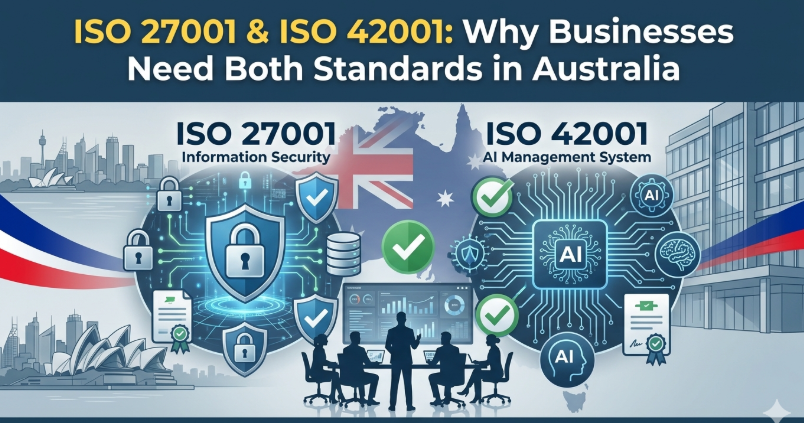
Australia’s business landscape is undergoing rapid digital transformation. From cloud computing and automation to artificial intelligence (AI) and data analytics, organisations are increasingly relying on technology to improve efficiency, enhance customer experiences, and drive growth.
However, digital innovation brings new challenges. Businesses must not only protect sensitive information from cyber threats but also ensure that AI systems are developed and used responsibly. As cyber risks and AI-related concerns continue to evolve, organisations need governance frameworks that address both areas effectively.
This is where ISO 27001 and ISO 42001 play a critical role.
While these standards focus on different aspects of organisational governance, they work together to help businesses build trust, improve compliance, and manage risk in an increasingly digital environment.
Understanding ISO 27001: The Foundation of Information Security
Information is one of the most valuable assets an organisation possesses. Customer records, financial data, intellectual property, employee information, and operational systems all require protection from unauthorised access, loss, and cyberattacks.
ISO 27001 is the internationally recognised standard for Information Security Management Systems (ISMS). It provides a structured framework for identifying security risks, implementing controls, and continuously improving information security practices.
Across Australia, organisations are adopting ISO 27001 to strengthen their cyber resilience and demonstrate their commitment to protecting sensitive information.
Professionals pursuing a PECB ISO 27001 Certification in Australia develop the skills needed to implement, manage, audit, and improve information security management systems. This expertise is increasingly valuable as organisations face growing regulatory requirements and cybersecurity threats.
Industries such as healthcare, finance, education, government, and technology have particularly embraced ISO 27001 as a benchmark for security excellence and stakeholder confidence.
Understanding ISO 42001: Managing AI Responsibly
Artificial intelligence is rapidly transforming how Australian businesses operate. Organisations are using AI-powered tools to automate processes, improve decision-making, personalise customer experiences, analyse data, and increase productivity.
While AI creates significant opportunities, it also introduces risks that traditional information security frameworks do not fully address.
Some of the most common concerns associated with AI include:
- Bias in automated decision-making
- Lack of transparency in AI-generated outcomes
- Data privacy and protection issues
- Regulatory and compliance risks
- Ethical concerns surrounding AI use
- Accountability for decisions influenced by AI systems
Recognising these challenges, the International Organization for Standardization introduced ISO 42001, the world’s first Artificial Intelligence Management System (AIMS) standard.
ISO 42001 provides organisations with a framework for governing AI systems responsibly throughout their lifecycle. It helps organisations establish policies, controls, and oversight mechanisms that support transparency, accountability, and ethical AI practices.
Businesses Professionals who earn a PECB ISO 42001 Certification in Australia gain practical knowledge in AI governance, risk management, compliance, and responsible AI implementation.
As AI adoption continues to accelerate across Australia, expertise in AI governance is becoming increasingly important for executives, compliance professionals, risk managers, and technology leaders.
ISO 27001 vs ISO 42001: What Is the Difference?
Although both standards focus on risk management and governance, they address different business challenges.
ISO 27001 Focuses On:
- Information security
- Cybersecurity risk management
- Data confidentiality, integrity, and availability
- Security controls and policies
- Incident management and response
ISO 42001 Focuses On:
- Artificial intelligence governance
- Ethical and responsible AI use
- Transparency and accountability
- AI risk assessment and monitoring
- Regulatory compliance related to AI systems
In simple terms, ISO 27001 helps organisations protect information, while ISO 42001 helps organisations govern how AI technologies use that information.
Rather than replacing one another, the two standards complement each other and form a comprehensive governance framework for modern businesses.
Why Australian Businesses Need Both Standards
Many organisations initially focus on cybersecurity because it is a more familiar risk area. However, as AI becomes embedded in business operations, AI governance is emerging as an equally important consideration.
An AI system is only as reliable as the data and governance processes supporting it.
For example, a business may have excellent cybersecurity controls under ISO 27001, but still face reputational or regulatory risks if its AI systems produce biased, inaccurate, or non-transparent outcomes.
Likewise, an organisation may establish strong AI governance policies through ISO 42001 but remain vulnerable if the underlying data and systems are not adequately protected.
Together, ISO 27001 and ISO 42001 help organisations address both challenges.
Benefits of implementing both standards include:
- Stronger enterprise-wide risk management
- Improved regulatory readiness
- Enhanced customer and stakeholder trust
- Better protection of sensitive information
- Responsible and transparent AI deployment
- Greater operational resilience
- Improved business reputation
- Increased competitive advantage
For Australian organisations navigating digital transformation, combining both frameworks provides a more complete approach to governance and risk management.
See Also: What Makes an Automotive Milestone Worth Celebrating?
Preparing for Australia’s Evolving Regulatory Environment
Governments and regulators around the world are paying increasing attention to cybersecurity, privacy, and artificial intelligence.
Australia is no exception.
As regulatory expectations continue to evolve, organisations that proactively implement recognised management systems will be better positioned to demonstrate compliance and adapt to future requirements.
Businesses that adopt ISO 27001 and ISO 42001 early can also differentiate themselves in the marketplace by demonstrating their commitment to security, transparency, and responsible innovation.
Customers, investors, business partners, and regulators increasingly expect organisations to manage both cyber risks and AI-related risks effectively.
How Risk Professionals Supports Certification Success
Successfully implementing management system standards requires more than simply understanding the requirements. Organisations and professionals need practical knowledge, expert guidance, and recognised training pathways.
Risk Professionals helps individuals and organisations build the skills needed to implement, maintain, and improve both information security and AI governance frameworks.
Through professional training programmes, certification preparation, and industry-focused learning resources, Risk Professionals supports those pursuing internationally recognised qualifications such as PECB ISO 27001 Certification and PECB ISO 42001 Certification.
Whether an organisation is strengthening its cybersecurity posture or establishing a formal AI governance framework, the right training can significantly improve the likelihood of successful implementation and certification.
Building Future-Ready Organisations
The future of business will be shaped by two critical priorities: protecting information and governing artificial intelligence responsibly.
Organisations that focus solely on cybersecurity may overlook emerging AI risks, while those concentrating only on AI governance may expose themselves to unnecessary security vulnerabilities.
By adopting ISO 27001 and ISO 42001 together, businesses can establish a strong foundation for secure innovation, regulatory compliance, and long-term growth.
As Australia’s digital economy continues to evolve, organisations that embrace both information security and responsible AI governance will be better positioned to build trust, reduce risk, and maintain a competitive advantage.
Conclusion
The question is no longer whether organisations should invest in cybersecurity or AI governance. In today’s business environment, both are essential.
ISO 27001 provides the framework needed to protect critical information assets, while ISO 42001 helps organisations ensure AI technologies are managed responsibly, ethically, and transparently.
Together, these internationally recognised standards offer Australian businesses a practical roadmap for managing digital risk, strengthening stakeholder confidence, and preparing for the future.
For organisations seeking sustainable growth in an increasingly technology-driven world, implementing both standards is quickly becoming a strategic necessity rather than a competitive advantage.